What You Will Learn in This Guide
1. What a trading plan is and why professional traders treat it as non-negotiable.
2. The 10 essential sections every complete Forex trading plan must include.
3. How to define your trading style, goals, strategy rules, and risk parameters in writing.
4. Common trading plan mistakes that undermine even skilled traders.
5. How your trading plan connects to prop firm challenges, trading journals, and long-term growth.
6. A complete, ready-to-use AfroTrader Academy Trading Plan Template at the end of this guide.
Introduction
Every profitable trader has a trading plan. Every struggling trader thinks they have one.
That sentence contains the single most important distinction in retail trading. Having a vague idea of how you trade is not a trading plan. Knowing which indicators you like is not a trading plan. Intending to manage risk properly is not a trading plan. A trading plan is a written document that is specific, structured, and detailed enough that a stranger could read it and understand exactly how you trade, what setups you take, how much you risk on each trade, and how you evaluate your own performance over time.
Traders without written plans make decisions in real time under financial pressure. They improvise entries. They move stop losses. They increase position sizes after winning streaks and reduce them after losses. They trade out of boredom and avoid trading when they should be active. Every one of these behaviours is a product of making decisions without a pre-defined framework. Every one of them is preventable.
Traders with written plans have already made these decisions before the market opens. Their entry criteria are defined. Their position sizes are calculated from a formula. Their stop losses are placed before execution. Their daily stop is a number they committed to before seeing a single candle. The plan does not make every trade a winner. It makes the trader’s behaviour consistent, and consistency is what allows an edge to compound over time.
This guide walks through every component of a complete Forex trading plan, explains what each section should contain and why, and provides a free Trading Plan Template at the end for you to complete and keep.
Every successful trader was once a beginner who made a plan and stuck to it. Every failed trader was once a beginner who made a plan and abandoned it the moment it was uncomfortable.
What Is a Trading Plan and Why Does It Matter?
A trading plan is a written document that defines every aspect of how you approach the market. It covers your goals, your strategy, your risk management rules, your daily routine, your evaluation process, and your personal rules for managing the psychological pressures of live trading. It is the operating manual for your trading practice.
The most accurate analogy is a business plan. No serious entrepreneur would launch a business without defining their target market, their product, their cost structure, their revenue model, and their performance metrics. Trading is a business. Your account is the capital. Your strategy is the product. Your risk management rules are the cost structure. Your win rate and risk-to-reward ratio are the performance metrics. The trading plan is the document that ties all of these together.
What a Trading Plan Is Not
- It is not a list of indicators: Indicators are tools. A plan specifies the exact conditions under which those tools generate a valid trade signal.
- It is not a strategy: A strategy is one component of a plan. The plan also covers goals, risk management, session timing, evaluation, and psychology.
- It is not a wish list: Statements like ‘I want to make consistent profits’ are not plan content. Plans contain specific, measurable, enforceable rules.
- It is not static: A good trading plan is reviewed and updated regularly as your skills develop, your strategy evolves, and your risk capacity changes.
The Evidence for Trading Plans
Research consistently shows that traders with documented, structured plans perform significantly better than those without them. Specifically, traders with backtested, written strategies pass prop firm challenges at approximately 40% compared to 15% for traders without one. Professional traders with written risk rules experience smaller maximum drawdowns. And traders who review their plans weekly maintain more consistent position sizing and fewer emotional rule violations than those who do not.
The plan does not produce the trades. The trader does. But the plan produces the consistency of behaviour that determines whether good trades compound into sustainable returns or get erased by preventable mistakes.
The 10 Sections of a Complete Forex Trading Plan
A complete Forex trading plan covers ten distinct areas. Each section serves a specific function in guiding your behaviour before, during, and after every trading session. Skipping any section leaves a gap that market pressure will eventually exploit.
Section 1: Trader Profile and Goals
The first section of your trading plan establishes who you are as a trader and what you are specifically trying to achieve. This matters because different goals require different approaches, different timeframes, and different definitions of success.
Your trader profile should define your current experience level honestly, the capital you are trading with, your financial goals, and your timeline. Specific, measurable goals are significantly more useful than vague aspirations.
Examples of specific versus vague goals:
- Vague: I want to make consistent profits from Forex trading.
- Specific: I aim to achieve a 5% return on my $2,000 account over 6 months while maintaining a maximum drawdown of 8% and completing at least 40 quality trades.
The specific goal gives you three measurable targets: return percentage, drawdown limit, and trade volume. Each can be tracked. Each tells you something meaningful about your progress. The vague goal tells you nothing except whether you made money this month.
Your trader profile should also include your longer-term goal: are you trading to supplement income, to eventually fund a prop firm challenge, to build toward full-time trading, or to develop a skill for its own sake? This long-term context shapes how aggressively you should grow your account, how much drawdown is acceptable, and how much time you should invest in education versus active trading.
Goal-Setting Framework for Forex Traders
Short-term goal (next 3 months): Define a specific return target, maximum drawdown limit, and minimum trade count.
Medium-term goal (6–12 months): Define the account size you want to reach, the consistency metrics you want to achieve, and the next skill level you want to attain.
Long-term goal (1–3 years): Define your trading ambition, this could be; prop firm funding, consistent part-time income, or full-time professional trading.
Section 2: Markets and Trading Instruments
This section defines which markets and currency pairs you will trade and, equally importantly, which you will not. Specificity here protects you from the common beginner trap of jumping between pairs whenever a current one is not producing results.
For Forex beginners, the correct starting point is one to three major pairs at most. EUR/USD is the universal recommendation. It offers the tightest spreads, highest liquidity, the most technically readable price behaviour, and the largest community of educational resources. Adding GBP/USD or USD/JPY as a secondary pair is appropriate once you have consistent results on your primary.
Beyond specifying which pairs you trade, this section should also specify your platform (MT4 or MT5), your broker, the account type (standard or ECN), and the standard spread you expect on your primary pair. These details ensure you account for trading costs accurately when evaluating strategy performance.
Section 3: Trading Style and Timeframes
Your trading style determines your timeframes, your strategy, your time commitment, and the psychological demands your trading approach places on you. There are four primary styles:
Trading Style Reference: Choose the Right Fit
| Style | Hold Time | Timeframes | Trades/Month | Time Required | Best For |
| Scalper | Seconds to minutes | M1, M5 | 50–100+ | Very high | Active screen monitoring |
| Day Trader | Minutes to hours | M15, H1 | 5–20 | High | Available during session |
| Swing Trader | 1–30 days | H4, D1 | 1–5 | Moderate | Part-time friendly |
| Position Trader | Months to years | D1, W1 | 1–4/month | Lower | Busy professionals |
Most beginners gravitate toward day trading because it feels most active and most like the trading they have seen on social media. However, swing trading is typically the most practical starting point for African traders who have work or study commitments during peak trading hours, because it accommodates analysis and trade management outside of market hours without requiring real-time monitoring.
Your trading style choice is not permanent but it should remain fixed for a meaningful period. Switching between scalping, day trading, and swing trading based on recent performance is one of the most reliable ways to never develop expertise in any of them.
Section 4: Market Analysis Method
This section defines how you analyse the market before deciding whether a trade opportunity exists. It is one of the two most critical sections of the plan because it determines the quality and consistency of your trade selection.
Your analysis method should cover two layers: top-down analysis (how you identify the overall market context and direction) and entry-level analysis (how you identify specific trade setups within that context).
Top-Down Analysis
Top-down analysis means starting with a higher timeframe to establish context before dropping to your entry timeframe for precision. A swing trader might begin on the weekly chart to identify the dominant trend direction, move to the daily chart to identify key support and resistance levels, and then use the 4-hour chart to time entries. This hierarchical structure ensures that individual trade entries align with the broader market direction rather than working against it.
Entry-Level Analysis
Your entry-level analysis defines the specific conditions that must be present on your entry timeframe before you will consider a trade. These conditions must be objective and repeatable, not subjective and variable.
Examples of objective versus subjective entry criteria:
- Subjective (not usable as plan criteria): Enter when the trend looks bullish and price is near a support area.
- Objective (usable as plan criteria): Enter long when price is in an uptrend (higher highs and higher lows on H4), price has pulled back to and bounced from a key horizontal support level, and a bullish engulfing candle has closed above the level on H1.
The test of whether your entry criteria are objective enough is whether a different trader following your plan would identify the same setups you identify. If the answer is no, your criteria are not specific enough.
Build Your Technical Analysis Foundation First
AfroTrader Academy’s Forex Trading Course covers all the technical analysis tools – support and resistance, market structure, candlestick patterns, and trend analysis that form the foundation of any objective entry criteria.
Learn more: View the AfroTrader Forex Course
Section 5: Entry and Exit Rules
Entry rules define the exact conditions that must be met before you will open a position. Exit rules define both when you will close a losing trade (stop loss) and when you will close a profitable trade (take profit or trailing exit).
Entry Rules
A valid entry rule has three components: a setup condition (what pattern or signal must be present), a confirmation condition (what must confirm the setup before you act), and an invalidation condition (what would tell you the setup is no longer valid before your entry is triggered).
For example, a swing trader’s entry rule might state: Setup:- price has formed a double bottom at a key support level on H4. Confirmation:- price has broken the neckline (the high between the two bottoms) with a close above it on H4. Invalidation:- if price falls below the second bottom before the neckline break, the setup is invalid and no trade is taken.
Stop Loss Rules
Your stop loss rule defines where your trade idea is wrong. It should always be based on market structure, not on a pip distance from entry or a loss amount you are comfortable with.
The three most widely used stop loss methodologies are:
- Structure-based: Stop placed beyond the most recent significant swing high (for short trades) or swing low (for long trades). The trade is wrong if price breaks that structural level.
- Volatility-based: Stop placed at a distance from entry calculated using the Average True Range (ATR), accounting for the instrument’s typical daily range.
- Level-based: Stop placed beyond a specific key level which might be, a previous high, a support or resistance zone, or a moving average that the trade thesis requires to hold.
What all three approaches have in common is that the stop is placed where the trade is wrong, not where the loss becomes acceptable. If the market-based stop implies a larger loss than your risk percentage allows, the solution is to reduce your position size, not to move the stop closer.
Take Profit Rules
Your take profit rule defines where you exit a profitable trade. This can be a fixed target (a specific price level), a risk-to-reward ratio (close at 2x the risk), or a trailing exit (move the stop loss behind price as it progresses in your favour).
Whichever method you choose, it should be defined before you enter the trade, not decided in real time while the trade is open. Real-time take profit decisions are subject to greed (holding too long) and fear (exiting too early) in ways that pre-defined targets are not.
Section 6: Risk Management Rules
This is the most important section of your trading plan. Every other component of the plan determines what trades you take. This section determines whether you survive long enough for those trades to compound into meaningful results.
Risk Per Trade
Define a fixed percentage of your account that you will risk on every single trade. For beginners, this should be between 0.5% and 1%. For developing traders with a verified track record, up to 2% is acceptable. Never risk more than 2% of your account on any single position.
Risk Per Trade Reference: What the Numbers Actually Mean
| Account | Risk % | $ Per Trade | 10-Loss Scenario | Assessment |
| $500 | 1% | $5 | 10 consecutive losses = $50 drawdown (10%) | Appropriate for demo-to-live transition |
| $1,000 | 1% | $10 | 10 consecutive losses = $100 drawdown (10%) | Appropriate for beginner live account |
| $5,000 | 1% | $50 | 10 consecutive losses = $500 drawdown (10%) | Appropriate for developing traders |
| $5,000 | 2% | $100 | 10 consecutive losses = $1,000 drawdown (20%) | Aggressive — not recommended |
| $10,000 | 1% | $100 | 10 consecutive losses = $1,000 drawdown (10%) | Standard professional parameter |
| $10,000 | 0.5% | $50 | 10 consecutive losses = $500 drawdown (5%) | Conservative — ideal during drawdowns |
Position Sizing
Position size must be calculated before every trade using the formula:
Position Size Formula
Risk Amount = Account Balance × Risk Percentage
Position Size = Risk Amount ÷ (Stop Loss in Pips × Pip Value)
Example: $5,000 account | 1% risk | 50 pip stop loss | $1 pip value (mini lot on EUR/USD)
Risk Amount = $50 | Position Size = $50 ÷ (50 × $1) = 1 mini lot (0.1 standard lot)
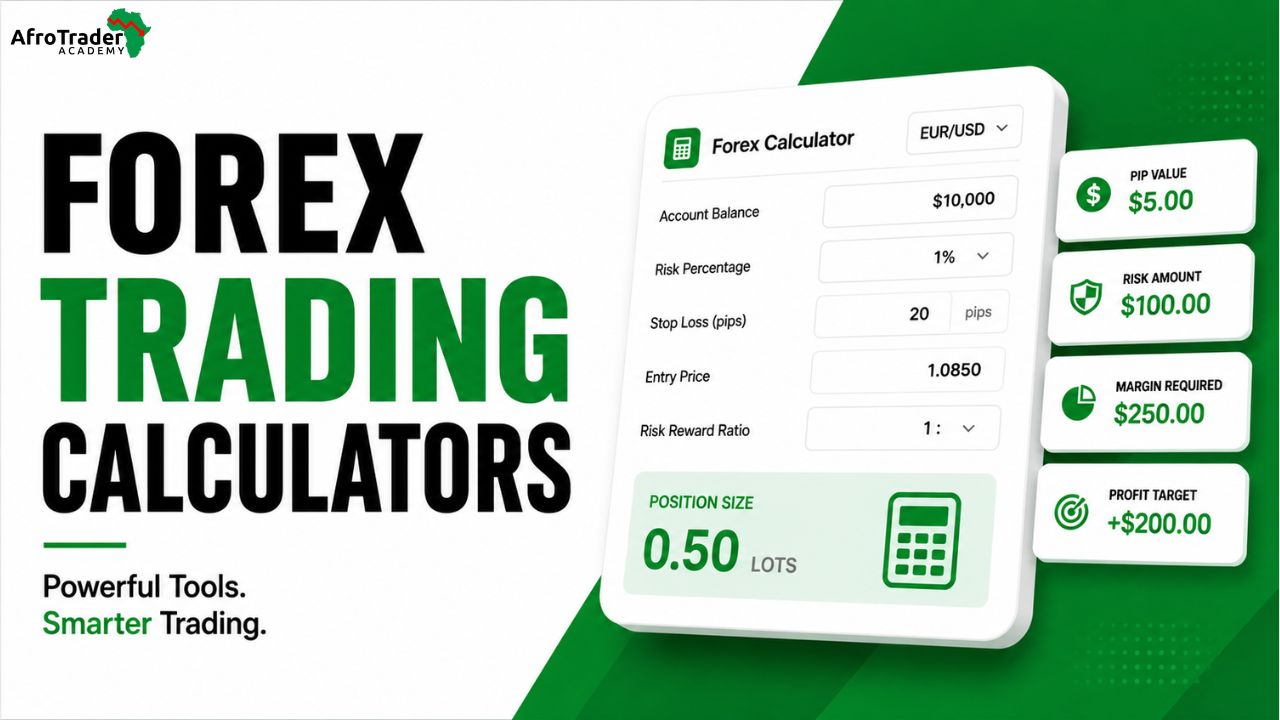
Use AfroTrader Academy’s free Position Size Calculator here:
Daily Loss Limit
Define the maximum amount you will lose in a single trading day before stopping all activity for that day. The standard recommendation is 3% to 5% of account balance. When you hit this limit, you close your platform and do not return until the next session. This single rule prevents more catastrophic drawdowns than any other risk management measure.
Weekly Loss Limit
Define the maximum you will lose in a single week. A weekly limit of 6% to 10% creates a second circuit breaker that prevents a bad week from becoming a devastating one. If you hit your weekly limit mid-week, you stop trading for the remainder of the week, review your trading journal, and return the following week with a clear analysis of what went wrong.
Maximum Overall Drawdown
Define the maximum drawdown from your account peak at which you will pause all live trading and conduct a full strategy review. This is typically 15% to 20% for retail traders. A drawdown of this magnitude indicates that either market conditions have changed significantly, your strategy has a flaw that was not visible in normal conditions, or your execution discipline has broken down. All three require review before resuming normal trading.
Minimum Risk-to-Reward Ratio
Define the minimum ratio of potential profit to potential loss that a setup must offer before you will take the trade. The standard minimum is 1:2, meaning for every $1 risked, the potential reward must be at least $2. This ensures mathematical viability even a 40% win rate produces positive expected value at 1:2 risk-to-reward.
Section 7: Trading Sessions and Schedule
Define when you will trade. This means specifying which market sessions you will be active in, your daily trading window in your local timezone, and the days of the week you will trade.
For African traders, the London session (opening at 11:00 AM East Africa Time and 10:00 AM Central Africa Time) is the most practically aligned with business hours for traders across the continent. The London-New York overlap (4:00 PM to 8:00 PM EAT, 3:00 PM to 7:00 PM CAT) offers the highest liquidity and the most technically reliable price action of the trading day.
Beyond specifying which sessions you will trade, your plan should also define when you will not trade. Specifically:
- Within 15 to 30 minutes before and after high-impact news events on your traded pairs
- On days with no clear setups meeting your full entry criteria
- During the first 30 minutes of any session (before session direction is established)
- After reaching your daily loss limit
- When your emotional state is noticeably affected by recent trading results
The last item deserves specific attention. Defining emotional trading as a no-trade condition in your plan makes it a rule rather than a subjective judgment. Traders who have committed in writing to not trading when emotionally reactive are significantly more likely to follow through than those who make the same decision in the moment.
Section 8: Trade Management Rules
Trade management covers everything that happens between entering a position and closing it. Many trading plans define entry conditions in detail and then leave trade management entirely to real-time judgment. This is one of the most common and most expensive plan gaps.
Moving Your Stop Loss to Break Even
Define the conditions under which you will move your stop loss to your entry price (break even). A common rule is to move to break even when the trade has moved 50% of the way to the take profit target. This removes the risk of a profitable trade turning into a loss. However, define this rule specifically and apply it consistently. Moving stop losses to break even before the defined condition is met because a trade feels like it should be protected is not trade management. It is emotional interference.
Partial Profits
Define whether you will take partial profits at intermediate targets. Some traders close 50% of a position at the 1:1 risk-to-reward level and hold the remainder for the full target. This reduces overall profitability per trade in the long run but provides emotional stability during the latter portion of a trade. If partial profits are part of your approach, specify the exact conditions triggering each partial close.
Trailing Stop Rules
If you use a trailing stop to lock in profits as price progresses, define the trailing mechanism precisely. Does the stop trail by a fixed pip distance? By ATR? By candle structure (moved to the most recent swing low in an uptrend)? Undefined trailing stops are applied inconsistently, which produces erratic trade outcomes.
Section 9: Psychology and Personal Rules
This is the section most traders find uncomfortable to write because it requires honest self-assessment of personal weaknesses. It is also the section that differentiates a functioning professional plan from a textbook exercise.
Your psychology section should specifically address the emotional patterns that you have observed in your own trading. Not generic trading psychology concepts. Your specific patterns.
Common personal rules worth including:
- The Revenge Trading Rule: I will not take a trade within 30 minutes of a stopped-out position. I will step away from the platform for 30 minutes after any loss that triggers a strong emotional response.
- The Winning Streak Rule: After three consecutive winning trades, I will reduce my position size by 25% for the next five trades. Overconfidence during winning streaks is as dangerous as desperation during losing ones.
- The News Rule: I will check the economic calendar every morning before my session. I will not hold a position through any high-impact event without having specifically planned for the scenario.
- The Daily Review Rule: Before closing my platform each day, I will spend ten minutes completing my trading journal entry. I will not trade the following day if yesterday’s journal has not been completed.
The psychology section of your trading plan works best when it is written based on your actual trading history. If you do not yet have live trading experience, write this section provisionally and update it after your first month of demo or live trading based on what you actually observe about your own behaviour.
Section 10: Review and Improvement Process
The final section defines how and how often you will evaluate your trading performance and update your plan. A trading plan without a built-in review process is a document that gradually becomes obsolete as market conditions change and your skills develop.
Daily Review
At the end of each trading session, complete your trading journal entry. Review each trade against your plan’s entry and exit criteria. Grade compliance, not just outcome. A losing trade that followed the plan perfectly is a more valuable data point than a winning trade that violated the rules.
Weekly Review
At the end of each trading week, review your performance metrics: total trades, win rate, average risk-to-reward achieved, total gain or loss as a percentage of account, and any rule violations noted in the daily journal. Identify patterns in your winning trades and your losing trades. Which setups performed best? Which setups underperformed? Were there any sessions or market conditions where your strategy consistently failed?
Monthly Review
At the end of each month, conduct a deeper analysis of your overall progress against the goals defined in Section 1. Are you on track for your 3-month return target? Is your drawdown within the planned parameters? Have any new patterns emerged in your trading that should be addressed in your plan? Monthly reviews are also the appropriate time to consider whether any specific rule changes are warranted based on accumulated data.
Plan Update Protocol
Define the conditions under which you will update specific sections of your plan. Rule changes should not be made impulsively based on a single bad session. The appropriate triggers for plan updates are consistent patterns observed across at least 20 to 30 trades, not individual outcomes. Always document what you changed, why you changed it, and what data supported the change. This creates a version history of your plan that is itself a valuable learning resource.
The Most Common Trading Plan Mistakes
Mistake 1: Building a Plan and Never Looking at It Again
A trading plan that sits in a document folder unused is not a trading plan. It is a completed exercise. The purpose of a trading plan is to guide behaviour during every single trading session. Print it. Keep it on your desk. Read the entry criteria before every trade. Review the risk rules before every session. The plan is only useful if it is the active reference you consult rather than the document you consult when something has already gone wrong.
Mistake 2: Writing Vague Entry Criteria
Entry criteria that cannot be tested objectively are not entry criteria. If you cannot look at a historical chart and determine with confidence whether a specific candle would have triggered your entry rule, your criteria are not specific enough. Every entry rule in your plan should be testable against historical price data.
Mistake 3: No Plan for Bad Days
Most trading plans define what to do when everything is working. Far fewer define what to do when the day is going badly. A trading plan without an explicit daily loss limit and a defined response to hitting that limit is incomplete. Bad trading days are inevitable. The plan should make the response to a bad day automatic rather than leaving it to real-time emotional decision-making.
Mistake 4: Abandoning the Plan During a Losing Streak
Every strategy goes through periods of underperformance. This is not evidence that the strategy is broken. It is a normal statistical property of all trading approaches. The traders who abandon their plan at the first losing streak never give their edge the sample size needed to prove itself. The traders who maintain their plan through temporary drawdowns and review it for genuine flaws rather than emotional ones are the ones whose equity curves eventually point in the right direction.
Mistake 5: Building Someone Else’s Plan
Copying a trading plan from a YouTube video, a social media post, or even a reputable educational source and following it without adaptation is not effective. A trading plan must match your specific psychology, schedule, capital level, risk tolerance, and strategy. The template in this guide provides the structure. You must provide the content based on your own situation and approach.
The AfroTrader Academy Trading Plan Builders for both live traders & prop firm funded traders


Your Trading Plan and Prop Firm Challenges
If one of your goals is to pass a prop firm challenge and access funded trading capital, your trading plan is not just a personal discipline tool. It is the operational document that determines whether you can meet the specific, rule-governed requirements of an evaluation challenge.
Every prop firm challenge has defined profit targets, daily loss limits, drawdown rules, and often consistency requirements. These rules are external constraints imposed on top of your own trading approach. Your trading plan must incorporate them explicitly when you are operating in challenge mode.
Specifically, your plan should include a prop firm section that defines how your standard risk parameters change during a challenge. During a challenge, your daily loss limit cannot exceed the firm’s stated limit. Your position sizes must be calculated to ensure that a normal losing streak does not approach the daily loss limit. Your consistency rule compliance must be tracked if your chosen firm applies one.
Trading Plan and Prop Firm Challenge: The Link
The traders who pass prop firm challenges consistently are not just skilled traders. They are traders whose written plan already incorporates the discipline, consistency, and risk management that prop firms specifically test.
If you build a rigorous trading plan and execute it consistently for 3 to 6 months before your first prop firm attempt, you are already operating at the standard the challenge is designed to measure.
For more on prop firm challenges, see our complete guide on how to pass a prop-firm challenge:

Your Trading Plan and Your Trading Journal
A trading plan and a trading journal are the two sides of the same coin. The trading plan defines the rules. The trading journal tracks compliance with those rules and generates the data needed to improve the plan over time.
Your trading journal is where you record every trade against the criteria defined in your plan. Was the entry criteria fully met? Was the stop loss placed at the correct structure-based level? Was the position size correctly calculated? Did you close the trade according to your take profit rule or did you deviate? These questions in the journal directly reference the rules in the plan.
Without a trading plan, your journal has no standard to measure against. Without a journal, your trading plan is never refined based on real performance data. The two tools are designed to work together as a single performance improvement system.
Coming Next in This Series
The second article in the Disciplined Trader Series covers trading journals in full: what to record, how to structure your journal, how to conduct weekly and monthly reviews, and the free AfroTrader Academy Trading Journal Builder.
Look for:

Final Thought
A trading plan is the most leveraged document a trader can create. The 2 to 3 hours required to complete it thoroughly will save you from months of inconsistent, emotionally driven trading and will prevent the most common and most costly mistakes that hold most retail traders back indefinitely.
The template above is not meant to be completed once and filed away. It is meant to be active, visible, and referred to every time you sit down to trade. Print it. Keep it beside your trading setup. Read Section 5 before every trade. Read Section 6 at the start of every session. Review Section 10 every Sunday.
The traders who use this trading plan builder consistently and honestly will develop the structural foundation that separates disciplined, long-term profitable traders from the majority who trade by feel, intuition, and hope. The market does not reward the most intelligent or the most analytical. It rewards the most consistent.
Risk Warning & Disclaimer
Trading Forex, Synthetic Indices, Cryptocurrencies and other leveraged financial instruments involves substantial risk and may not be suitable for all individuals. Leveraged trading can result in losses that exceed your initial capital. At AfroTrader Academy, we emphasize risk management, discipline and long-term consistency not shortcuts or guaranteed profits. The Academy provides educational content only and does not offer financial or investment advice. All trading decisions are the sole responsibility of the individual trader. Past performance does not guarantee future results. Please read our full Risk Disclosure and Disclaimer.


AfroTrader Academy is a professional trading education platform built to equip new and intermediate traders with the knowledge, structure, and discipline required to navigate modern financial markets. We focus on education over hype, process over profits, and skill development over shortcuts. Our mission is to help traders build a solid foundation, understand market behaviour, and develop repeatable trading frameworks they can apply independently.