
What You Will Learn in This Guide
1. Why 80–90% of challenge attempts fail and the mindset shift that separates those who pass.
2. A complete pre-challenge preparation framework including a 12-point checklist.
3. The exact risk management parameters used by consistently successful prop traders.
4. A phase-by-phase execution plan covering every stage from Day 1 to your first payout.
5. How to navigate the psychological traps that are unique to prop firm challenge conditions.
6. The rules that interact in ways most traders never anticipate before it costs them their challenge.
7. How to manage the funded account after passing without losing it on the first month.
8. Africa-specific guidance on payout setup, currency conversion, and scaling from the continent.
9. How to use the free AfroTrader Academy Prop Firm Challenge Plan Builder and Trading Journal to structure and track your challenge from Day 1.
Introduction
The prop firm challenge pass rate sits somewhere between 10% and 20% depending on the firm and the reporting period. That means between 80% and 90% of traders who pay a challenge fee fail to get funded. The conventional explanation for this statistic is that most traders are not good enough. That explanation is wrong.
The evidence from how challenges are actually lost tells a different story. Most traders who fail challenges do not fail because their strategy stopped working. They fail because they violated a rule. They overtraded on a bad day. They left a position open through a news spike. They hit the profit target in three days and then spent ten more days forcing trades. They increased their position size when they were in drawdown. They relaxed their discipline when they were close to passing.
These are not skill failures. They are execution failures. They are the product of trading under a specific set of psychological pressures that prop firm challenges create and that normal trading does not replicate. The good news is that execution failures are entirely correctable with the right preparation, the right framework, and the right mindset.
This guide is the most comprehensive, practical, step-by-step guide to passing a prop firm challenge available for African traders in 2026. It covers every stage from choosing the right challenge to managing the funded account after passing, with specific risk management frameworks, phase-by-phase execution plans, psychological management techniques, and Africa-specific payout guidance.
Prop firms do not test whether you can find good trades. Every trader occasionally finds good trades. They test whether you can follow a disciplined plan consistently over time under real financial pressure. That is the only thing they are measuring.
The Real Reason Most Challenges Fail
Before covering how to pass, it is worth being precise about why most traders fail. Understanding the actual failure mechanisms is more useful than generic advice about discipline and patience.
Failure Pattern 1: The Knowledge Gap Disguised as a Skill Gap
Most traders who fail challenges could have passed them if they had read their firm’s rules more carefully. Consistency rules, specific drawdown calculation methods, news trading restrictions, and minimum trading day requirements are all written in the challenge documentation. They cost traders their accounts not because the rules are unfair but because traders did not read them carefully enough to know the rules existed.
A trader who reads every rule document before starting a challenge has eliminated the single largest cause of avoidable challenge failure. This sounds obvious. Based on how most challenges end, it clearly is not obvious enough.
Failure Pattern 2: The Position Size Error
Traders who risk 2% to 5% per trade on a prop firm challenge with a 5% daily loss limit are giving themselves a margin for error of one to two losing trades before the daily limit is triggered. This is not a risk management framework. It is gambling with a countdown clock attached. Research consistently shows that traders risking 0.5% to 1% per trade pass at significantly higher rates than those risking 2% or more, because the smaller risk per trade provides the loss buffer needed to survive normal losing streaks without violating the daily limit.
Failure Pattern 3: The Psychological Pressure Trap
Prop firm challenge conditions create specific psychological pressures that regular trading does not. The deadline pressure of a challenge timeline. The performance anxiety of knowing every trade is being evaluated. The temptation to recover losses quickly when the daily limit is close. The overconfidence that comes from being near the profit target. Each of these is a distinct mental state that degrades decision-making in specific, predictable ways.
Traders who have not explicitly thought about how they will handle each of these psychological states before the challenge starts are at significant risk of falling into each trap when it appears. The traders who pass consistently are not necessarily calmer or more emotionally stable by nature. They have specific pre-defined responses to each trigger that override the emotional impulse before it becomes a decision.
Failure Pattern 4: Strategy Inconsistency
Some traders enter a challenge without a clearly defined strategy and attempt to trade whatever looks good on the chart each day. Others have a strategy but abandon it when it produces a string of losses and switch to something else mid-challenge. Both approaches guarantee a chaotic equity curve that either violates the consistency rule or the daily loss limit through unpredictable variance.
Passing a prop firm challenge requires one strategy, consistently applied, with defined entry criteria that do not change from day to day based on how recent trades have performed.
Step 1: Choose the Right Challenge Before You Pay
The first decision in the challenge process is choosing the right firm and the right account size for where you are in your trading development. This decision has more impact on your eventual pass rate than any other single factor.
Choose a Firm Whose Rules Match Your Trading Style
Not every firm’s rules are compatible with every trading approach. Before paying any challenge fee, answer these questions about the firm you are considering:
- Do you trade news events? Many firms prohibit trading within 2 to 5 minutes of high-impact news releases. If news trading is part of your strategy, verify the firm’s news policy explicitly before purchasing.
- Do you hold positions overnight or over weekends? Some firms restrict or prohibit overnight and weekend positions. Swing traders must verify these terms or choose a firm that explicitly permits overnight holds.
- Do you use an Expert Advisor? Most firms allow EAs but prohibit specific EA types including HFT, tick scalpers, and arbitrage systems. Verify your EA strategy is permitted before paying.
- Does the firm have a consistency rule? If you are a momentum trader who generates most profits during high-volatility sessions, a strict consistency rule that caps your best day at 30% to 50% of total profits will create a significant structural constraint on your approach.
- Is the drawdown static or trailing? If you are a swing trader who may hold positions through temporary adverse moves, static drawdown (which does not move against you as you profit) is more forgiving than trailing drawdown.
Choose the Right Account Size
A common mistake is choosing the largest account size a trader can afford the challenge fee for. A larger account does not make a challenge easier. It magnifies the dollar value of every rule and creates more psychological pressure.
The optimal starting account size for most traders attempting their first prop firm challenge is $25,000 to $50,000. These sizes provide meaningful profit potential while keeping the absolute dollar values of daily loss limits and drawdown thresholds at a psychologically manageable level.
If you are new to prop firm challenges specifically, start with the smallest available account size at your chosen firm, even if your capital comfortably allows a larger fee. Treat the first challenge as a learning experience and progressively scale to larger accounts as you demonstrate you can consistently follow the rules.
Read Every Document Before Paying
Read the challenge rules page, the FAQ, and the payout conditions page of any firm before paying a fee. Not the headline summary. Every page. Many firms bury critical conditions in the payout section that apply to the funded account rather than the challenge itself but that determine whether your challenge performance converts into actual income.
Step 2: The Pre-Challenge Preparation Framework
The preparation you do before Day 1 of the challenge determines how the challenge plays out. Traders who start a challenge without completing the preparation framework below are relying on in-the-moment discipline to manage rules they have not fully internalised. That is a dependency on willpower. Willpower is the least reliable resource available during a financially pressured trading environment.
The 12-Point Pre-Challenge Checklist
| Checklist Item | Where to Find / Action | Priority | Done |
| Read every rule document fully | Rules, FAQ, payout conditions page | Critical | |
| Confirm drawdown type (static vs trailing) | Challenge rules or contact support | Critical | |
| Note the daily loss limit and how it resets | Challenge rules document | Critical | |
| Check for consistency rules | Challenge rules — often in payout conditions section | Critical | |
| List all prohibited strategies | Challenge rules FAQ | Critical | |
| Confirm news trading policy | Challenge rules and firm FAQ | Important | |
| Note minimum trading days requirement | Challenge dashboard | Important | |
| Calculate your daily loss limit in dollars | Account size × daily loss % = your dollar limit | Important | |
| Set up MetaTrader alerts at 50% of daily limit | MT4/MT5 alert settings | Recommended | |
| Install a position size calculator | AfroTrader Academy free calculator | Recommended | |
| Create a daily trade log template | AfroTrader Academy Trading Journal (free, Prop Firm Mode included) at afrotrader.net/trading-journal-tool/ | Recommended | |
| Define your daily stop for the challenge | AfroTrader Academy Prop Firm Challenge Plan Builder (free) at afrotrader.net/prop-firm-challenge-plan-builder/ | Recommended |
Calculate Your Dollar Limits Before Day 1
Before the first trade of the challenge, convert every percentage-based rule into a dollar amount and write it down. These numbers should be visible at your trading station during every session:
- Daily Loss Limit in Dollars: Account Size × Daily Loss % = Your Dollar Limit. On a $100,000 account with a 5% daily limit: $100,000 × 0.05 = $5,000. You cannot lose more than $5,000 in any single day.
- Maximum Drawdown in Dollars: Account Size × Max Drawdown % = Total Dollar Floor. On a $100,000 account with a 10% static drawdown: your account cannot fall below $90,000 at any time during the challenge.
- Profit Target in Dollars: Account Size × Profit Target % = Dollar Target. On a $100,000 account with an 8% target: you need to reach $108,000 to pass Phase 1.
- Your Personal Daily Stop: This is your own internal limit, set below the firm’s daily loss limit. A trader with a 5% firm daily limit might set their personal daily stop at 3%. When they hit 3% down on the day, they stop trading — giving themselves a 2% buffer before a rule violation occurs.
Backtest Your Strategy First
If you have not backtested your strategy on the specific instrument and timeframe you plan to trade during the challenge, you are entering the challenge without knowing whether your approach has a genuine edge in current market conditions. Traders without backtested strategies pass at approximately 15% rates. Traders who have backtested their approach for 90 or more days pass at 40% or higher according to 2026 industry data.
Backtesting does not need to be complex. Go through the last 90 days of your chosen instrument’s price history and manually identify every setup your strategy would have triggered. Record the entry, stop loss, target, and outcome for each. Calculate your win rate, average risk-to-reward, and maximum consecutive losing streak. These three numbers tell you whether your strategy is viable for a prop firm environment and what level of consecutive losses to expect during normal operation.
Step 2B: Your Two Essential Free Tools Before Starting a Challenge
AfroTrader Academy has built two completely free tools designed specifically for prop firm traders. Setting both of these up before Day 1 of your challenge is as important as reading the firm’s rules. Traders who enter a challenge without a written plan and without a structured journal are relying on memory, willpower, and real-time decision-making under financial pressure. That is not a foundation that produces consistent results.
Tool 1: The AfroTrader Academy Prop Firm Challenge Plan Builder
The Prop Firm Challenge Plan Builder is an interactive form that walks you through building a complete challenge plan before you place your first trade. It has two modes: Challenge Mode for traders currently in an evaluation, and Funded Account Mode for traders who have passed and are managing live capital.
In Challenge Mode, the builder covers: your firm’s specific challenge structure (1-step, 2-step, or 3-step), the exact rules for each phase copied directly from your firm’s documentation, your personal risk parameters (risk per trade, personal daily stop, defensive mode trigger), your strategy and entry rules, your phase-by-phase execution plan with specific rules for each stage, your daily challenge dashboard with live input fields for balance, progress, and buffer remaining, and your psychological rules and weekly review commitment.
When you complete all sections and print the plan, you have a document that contains every rule, every dollar limit, every phase transition condition, and every personal commitment specific to your challenge. Keep it visible at your trading station. Read it before every session. The plan does not make every trade a winner. It makes your behaviour consistent, and consistency is what prop firms measure.
Free Prop Firm Challenge Trading Plan Builder
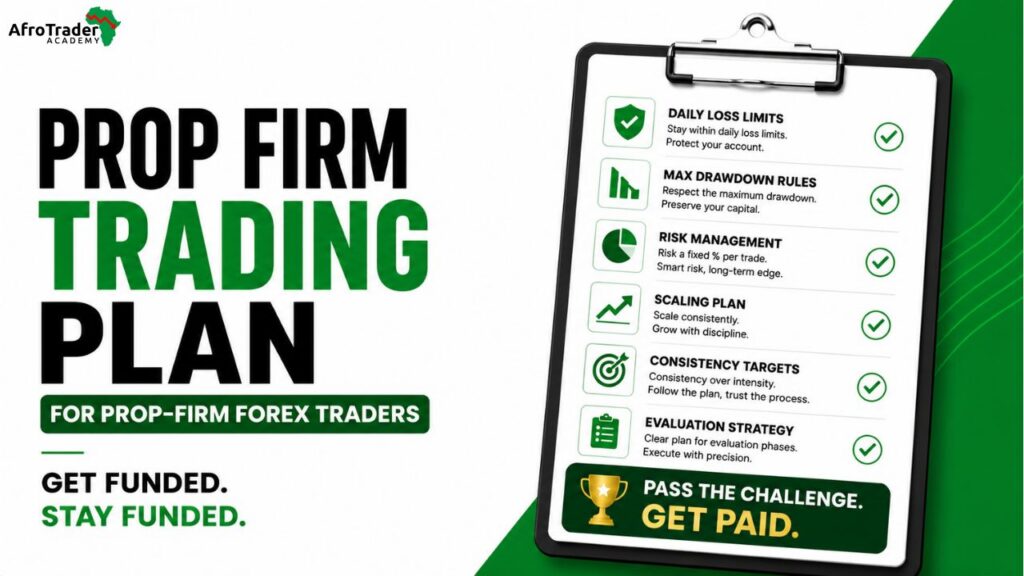
Access: Our Free Prop Firm Challenge Trading Plan Builder
Complete your challenge plan before Day 1. 1-step, 2-step, and 3-step challenge structures supported. Funded Account Mode included. Print or save as PDF at no cost. Nothing stored on any server.
Tool 2: The AfroTrader Academy Trading Journal
The AfroTrader Academy Trading Journal is a free, browser-based interactive journal built specifically for this community. It stores all data locally in your browser with nothing sent to any server. For prop firm challenge traders, the most important feature is Prop Firm Mode. When you enable this toggle in Settings, the journal adds a dedicated challenge tracking block to every trade entry that captures the data that determines whether your challenge succeeds or fails.
When Prop Firm Mode is active, each trade entry records: current account balance, progress toward the profit target, daily buffer remaining before the firm’s daily loss limit, current challenge phase (buffer building, main execution, defensive mode, consolidation, or funded), and consistency rule compliance status. These five data points after every trade give you an accurate, real-time picture of exactly where you stand in the challenge at all times.
The journal also tracks your plan compliance rate, emotional state scores before and after every trade, and setup type performance. Over 30 to 50 trades, the dashboard shows you exactly which setups are working, which sessions produce your best results, and how strongly your pre-trade emotional state correlates with your outcomes. This data makes the post-challenge review process in the failure recovery section of this guide genuinely diagnostic rather than based on memory and feeling.
The journal supports CSV export for backing up your data and is built for Forex, Crypto, and Synthetic Indices traders. If you already use a third-party journal such as TradeZella, Edgewonk, or Myfxbook, you can continue using it alongside the AfroTrader Academy journal or use whichever best fits your workflow. The critical thing is that you use a structured journal consistently throughout your challenge. Traders who journal consistently pass at higher rates than those who do not, because the journal makes rule violations visible in real time and gives you the data to adjust before a pattern becomes a violation.
Free AfroTrader Academy Trading Journal
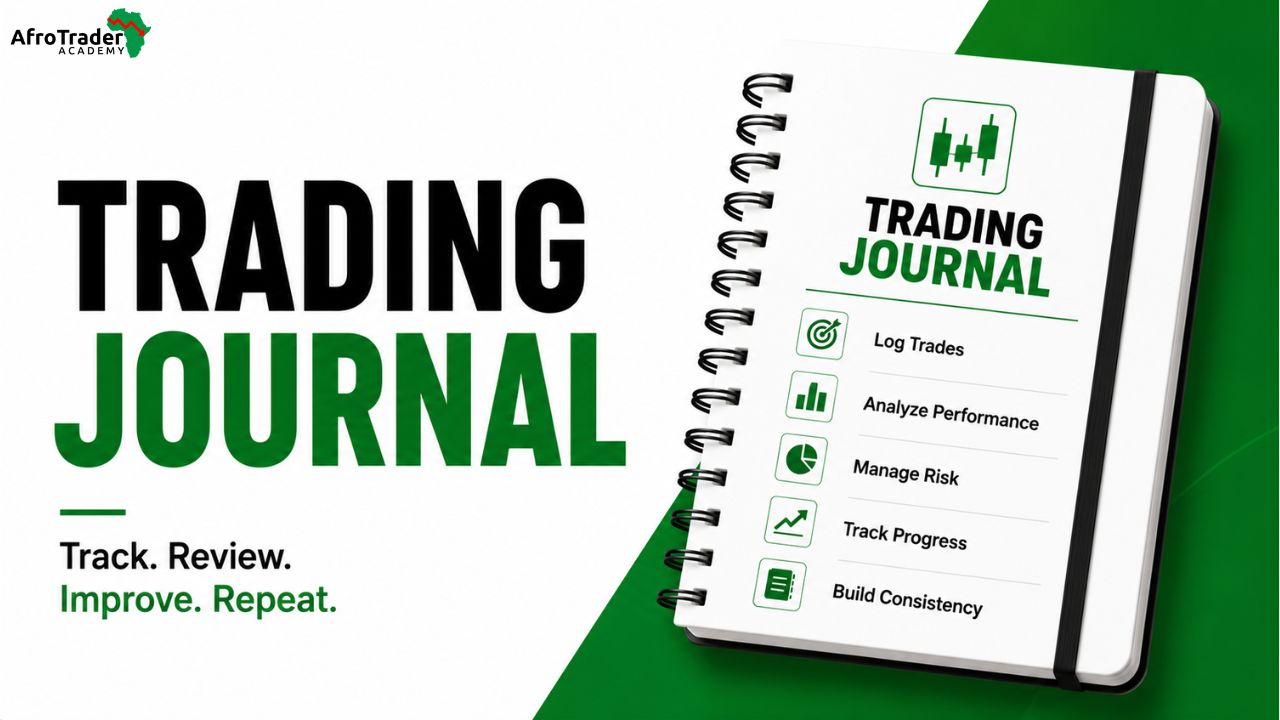
Access: Our Free Trading Journal
Dashboard, trade log, session review, and Prop Firm Mode. Stores data locally in your browser. Nothing sent to any server. No registration required.
Step 3: Risk Management Built Specifically for Prop Firm Challenges
Risk management for a prop firm challenge is not the same as risk management for a personal trading account. The rules impose specific constraints that require specific adaptations to standard risk management frameworks. This section covers those adaptations.
The Core Rule: 0.5% to 1% Risk Per Trade Maximum
This is the single most important risk management parameter for prop firm challenges. Risk per trade should never exceed 1% of the account balance during a challenge. For most traders starting out with prop firm challenges, 0.5% to 0.75% is an even more appropriate starting point. Here is the mathematical reason:
Risk Per Trade vs Daily Loss Buffer: Why It Matters
| Account | Risk % | $ Risk/Trade | Loss Buffer Before Daily Limit | Assessment |
| $10,000 | 1% per trade | $100 | 4 or 5 consecutive losses to hit 4% or 5% daily limit | We recommend you start with this account size |
| $25,000 | 1% per trade | $250 | 5 consecutive losses to hit 5% daily limit | Recommended for most traders |
| $50,000 | 1% per trade | $500 | 5 consecutive losses to hit 5% daily limit | Recommended |
| $100,000 | 1% per trade | $1,000 | 5 consecutive losses to hit 5% daily limit | Recommended for experienced traders |
| $100,000 | 0.5% per trade | $500 | 10 consecutive losses to hit 5% daily limit | Most conservative and safest |
| $100,000 | 2% per trade | $2,000 | 3 consecutive losses to hit 5% daily limit | Too aggressive for most traders |
The table above illustrates why 1% risk and below provides a meaningful buffer against normal losing streaks while keeping the daily loss limit realistically achievable through normal variance. A trader risking 2% per trade on a $100,000 account needs only three consecutive losses to hit the 5% daily limit and face account termination.
Never Risk More Than Your Comfortable Daily Stop
Your personal daily stop, the amount you will stop trading for the day before you approach the firm’s daily limit should be set before the challenge starts and treated as an absolute rule. A trader whose personal daily stop is 3% will never come close to the firm’s 5% daily limit. This buffer is the difference between a bad day and a rule violation.
Set a price alert in MetaTrader at 50% of your daily loss limit. When the alert triggers, reduce your position size for the remainder of the session. Set a second alert at 75% of the daily limit. When that triggers, stop trading for the day and do not return to the screen until the next session.
Position Sizing Must Be Calculated Before Every Trade
Use our free Position Size Calculator before every single trade during a challenge. The calculation takes 60 seconds. Entering a trade with an estimated lot size rather than a calculated one is an unnecessary risk that has ended challenges through accidental oversizing.
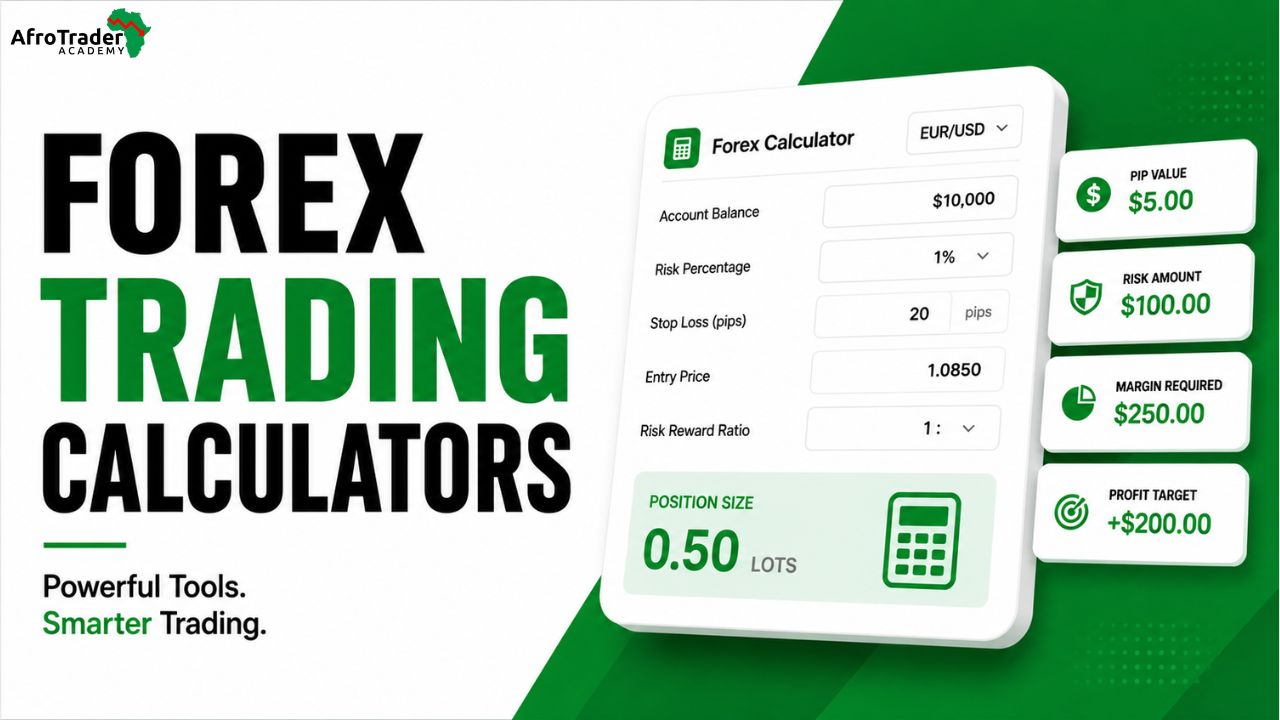
Learn more: Access Our Free Trading Calculators
Calculate the exact lot size for every challenge trade in seconds. Enter your account balance, risk percentage, stop loss distance, and pair. The calculator does the rest.
Adjust Risk for Market Conditions
Not all trading days carry the same risk profile. On days with multiple high-impact news events scheduled, reduce your risk per trade to 0.25% to 0.5% or avoid trading around the events entirely. On days with no significant news scheduled and clearly readable chart structure, your standard 0.5% to 1% risk is appropriate. Never increase risk above your standard level because the chart looks particularly clear or because you feel confident after a winning session.
Minimum Risk-to-Reward of 1:2 on Every Trade
Only take trades where the potential reward is at least twice the potential risk. This minimum standard means your strategy can have a win rate below 50% and still be profitable over a challenge period. A 45% win rate with a consistent 1:2 risk-to-reward produces positive expected value and a net profitable challenge outcome regardless of the individual session variance.
Step 4: The Phase-by-Phase Challenge Execution Plan
The most useful way to think about a prop firm challenge is as a series of distinct phases, each with a different objective, different risk profile, and different psychological requirements. Treating the challenge as one continuous grinding effort from Day 1 to target produces erratic behaviour. Thinking in phases produces structured, intentional progression.
Prop Firm Challenge: Phase-by-Phase Execution Plan
| Stage | Phase Name | Key Behaviour | Progress | Mindset |
| Pre-Challenge | Preparation | Read all rules, backtest strategy, set up journal | 0% | Not started |
| Days 1–5 | Buffer Building | Risk 0.5–0.75%. Aim for 1–2% gain. Get comfortable. | 0–20% of target | Cautious |
| Days 6–15 | Main Push | Risk 1%. Execute setups confidently. Build toward target. | 20–75% of target | Steady |
| 75%+ of Target | Defensive Mode | Reduce risk to 0.5%. Tighter setup criteria. Protect gain. | 75–99% of target | Very conservative |
| Target Reached | Consolidation | Complete minimum trading days carefully. Small positions. | 100% of target | Minimal risk only |
| Phase 2 | Verification | Treat as a new challenge. Reset mindset. Same discipline. | 0% of Phase 2 | Fresh start mentality |
| Funded Account | Capital Deployed | Same rules, real stakes. Never relax standards. | Ongoing | Professional |
Phase 1: Buffer Building (Days 1 to 5)
The objective of the first few trading days is not to make significant progress toward the profit target. It is to get comfortable with the platform, the account size, and the psychological environment of the challenge at the lowest possible risk.
Risk 0.5% to 0.75% per trade during this phase. Take only your highest-conviction setups. Do not force trades because it is a trading day. If your setups do not appear, do not trade. The goal is to generate a small positive buffer of 1% to 2% that gives you room to have a losing day without immediately approaching a dangerous drawdown level.
Many traders make the mistake of entering the challenge aggressively from Day 1, motivated by the desire to reach the profit target quickly. This approach produces an equity curve with high early variance that is more likely to trigger a daily loss limit violation before the buffer phase is complete.
Phase 2: Main Execution (Days 6 to 75% of Target)
With a small buffer established, you can trade your normal strategy at your standard 1% risk per trade. Execute your setups consistently. Accept losses as a normal part of the process. Review your trade journal at the end of each session and look for any drift from your defined strategy rules.
Do not check your progress toward the profit target between sessions. Check your compliance with your rules. The profit target will arrive as a natural consequence of executing your strategy consistently. Traders who check their progress every hour and adjust their behaviour based on how far they are from the target introduce psychological noise that degrades decision quality.
Phase 3: Defensive Mode (75% to 100% of Target)
This is where challenges are most commonly lost. Not at the beginning when traders are cautious, and not in the middle when traders are in the flow of consistent execution. At the end, when they can see the finish line.
The three specific psychological traps that appear in this phase are overconfidence (relaxing discipline because the target feels close), greed (trying to finish faster by increasing position size), and recklessness (taking lower-quality setups out of impatience to complete the challenge).
The counterintuitive and empirically supported response to approaching the profit target is to tighten your rules rather than relax them. Reduce risk to 0.5% per trade. Raise your setup criteria. Lower your personal daily stop. Treat the last 25% of the journey to the target as the most careful portion of the entire challenge, because statistically it is the phase where the most accounts are lost.
Phase 4: Completing Minimum Trading Days
If you reach the profit target before completing your firm’s minimum trading days requirement, you must continue trading until the minimum is met. These sessions are psychologically uncomfortable because you are trading without a clear objective and the natural incentive to produce returns has been removed.
During forced continuation sessions, reduce your position size to the absolute minimum your broker allows, typically 0.01 lots. Take only the most obvious, clearly defined setups from your strategy. Stop trading each day after two to three quality setups regardless of how much time remains in the session. The objective is to complete the minimum days without generating unnecessary losses that could reverse your progress toward the target.
Phase 5: Phase 2 — Verification
The most important mindset principle for Phase 2 of a two-step challenge is this: treat it as a completely new challenge. Do not carry habits from Phase 1 into Phase 2, whether those habits are positive (overconfidence from a clean Phase 1) or negative (sloppy patterns that worked well enough to pass but were not correct).
Phase 1 challenges that are passed through two or three exceptional days rather than consistent daily execution are particularly dangerous leading into Phase 2, because the habits they reinforced are not representative of what Phase 2 requires. Review your Phase 1 trade journal honestly before starting Phase 2. If you got lucky, acknowledge it and commit to executing Phase 2 with the discipline the result did not actually require in Phase 1.
Step 5: Managing the Psychology of Prop Firm Challenges
Prop firm challenges create a specific set of psychological pressures that are distinct from personal account trading. Identifying these pressures in advance and having a pre-planned response to each is the difference between traders who pass consistently and those who fail the same challenge multiple times despite good strategy performance.
The Deadline Pressure Trap
Many challenges have a maximum number of calendar days, typically 30 to 60, within which the profit target must be reached. Traders who feel the deadline approaching begin to force trades that do not meet their entry criteria, increase position sizes to accelerate progress, and take higher-risk setups to compress the timeline. All of these responses reliably produce larger losses rather than faster target achievement.
The solution is to remove the calendar from your trading environment during challenge sessions. You know the deadline. Thinking about it every day while trading does not make it more achievable. It only introduces anxiety that degrades the quality of your trading decisions. Many reputable firms in 2026 including FTMO, FundedNext, and The5ers offer challenges with no time limit. If deadline pressure is a known weakness in your trading psychology, choosing a no-time-limit challenge is a practical structural solution.
The Near-Target Overconfidence Trap
When a trader is close to the profit target and can see funding within reach, a specific form of overconfidence frequently emerges. The trader begins to feel that the hard work is done, that passing is now inevitable, and that the remaining distance to the target is a formality. This state produces relaxed discipline, larger position sizes, and trades taken at lower-quality setups.
Pre-plan your response to being within 25% of the target. Write it in your trading plan before the challenge starts: When I reach 75% of my profit target, I will reduce my risk per trade to 0.5%, raise my setup criteria by requiring confirmation on a second timeframe, and set my personal daily stop at 2%.
The Recovery Impulse Trap
After a losing session that brings the account close to the daily loss limit, a strong emotional impulse to recover the loss before the day ends is almost universal. This impulse has a specific name in trading: revenge trading. And in a prop firm challenge environment, where the daily loss limit creates a hard stopping point that cannot be moved, revenge trading does not recover losses. It converts a manageable bad day into an account violation.
Pre-plan your response to hitting 50% of your daily loss limit. Write it down before the challenge starts: When I lose 2.5% in a single day (on a 5% limit account), I close all positions, close MetaTrader, leave my trading area, and do not return until the next session. This response must be automatic and non-negotiable.
The Consistency Rule Trap
For challenges with a consistency rule (maximum percentage of total profit from any single day), an exceptional trading day early in the challenge creates a structural problem. If you make 6% in one day on a 10% target challenge and the firm has a 50% consistency rule, your best day must not exceed 50% of your total profits. That means you must generate at least 6% more profit before requesting your payout (to bring the best day to 50% or below of the total).
The practical solution is to reduce position size after an exceptional day. If you generate 3% on a single day on a 10% target, your best day is already 30% of the target. Trading normally the next day with another large win could push you toward a consistency violation. Reduce to 0.25% risk per trade for the two to three days following any session that produces an outsized return relative to your typical daily performance.
Step 6: Daily Session Protocol – A Trading Day Template
Consistent challenge performance is partly a product of consistent process. Professional prop traders use a daily pre-session and post-session routine that prepares them to execute their strategy and allows them to review their compliance honestly afterward. Here is a practical template:
Pre-Session Routine (30 Minutes Before Trading)
- Check the Economic Calendar: Open Forex Factory and identify all red (high-impact) events scheduled for the session. Note the times and decide whether you will trade through them, avoid them, or reduce size around them.
- Calculate Current Account Status: Write down your current balance, your daily loss limit in dollars, your personal daily stop in dollars, and your distance from the profit target. These numbers should be visible on your screen during the session.
- Review Yesterday’s Session: Read your most recent journal entry. Were your trades within your defined strategy criteria? Were your position sizes correct? Any drift noted in yesterday’s review should be corrected before today’s session opens.
- Set MetaTrader Alerts: Set a price alert at 50% of your daily loss limit and a second at 75%. These alerts will trigger automatic responses to bad sessions without requiring real-time monitoring of your account balance during live trading.
- State Your Rules Out Loud or in Writing: Before placing the first trade, state your entry criteria, your risk per trade, and your personal daily stop. This primes your conscious mind to monitor for compliance during the session.
During the Session
- Only take trades that fully meet your defined entry criteria: Not trades that mostly meet it. Not trades where one condition is borderline. All criteria met or no trade.
- Calculate position size using the calculator before every entry: Not an approximation. The exact calculation every time.
- Place stop loss immediately upon entry: Before moving to monitor other pairs or do anything else on the platform. Stop loss first.
- Stop trading when your personal daily stop is reached: This is non-negotiable. Close MetaTrader. Leave the trading area. Do not monitor.
- Do not check your progress toward the profit target during the session: This introduces target anxiety that degrades intraday decision quality.
Post-Session Review (20 Minutes After Closing)
- Record every trade: Entry, exit, position size, stop loss, result in pips and dollars, setup type, and whether the trade met all defined entry criteria. Use the AfroTrader Academy Trading Journal at afrotrader.net/trading-journal-tool/ — enable Prop Firm Mode to activate the challenge-specific tracking fields that record your daily P&L versus the firm daily limit, distance to the drawdown floor, current challenge phase, and consistency rule status after every trade.
- Grade compliance, not just outcome: A losing trade that followed your rules perfectly is a better result than a winning trade that violated them. Evaluate your process, not just your P&L.
- Note any emotional states that influenced decisions: Impatience, overconfidence, fear, or frustration. Naming these specifically helps you anticipate and manage them in the next session.
- Calculate remaining progress metrics: Days remaining, distance to target, current drawdown from starting balance. Update these numbers for tomorrow’s pre-session review.
Step 7: Navigating Funded Account Rules After Passing
Passing the challenge is not the end of the process. It is the beginning of the part that actually matters. The funded account operates under the same risk rules as the challenge, but the psychological context shifts significantly. During the challenge, the financial consequence of failure was losing a challenge fee. On the funded account, the consequence of failure is losing access to real capital and the income stream that comes with it.
The First Month of a Funded Account
Treat the first month of a funded account as a fifth phase of the challenge process rather than as independent trading. Apply the same risk parameters (0.5% to 1% per trade), the same daily session protocol, and the same rules compliance discipline that you used to pass.
The most common way traders lose funded accounts is by relaxing their discipline immediately after receiving the funded access. The reasoning is usually that the pressure of the challenge is over and they can now trade more freely. This reasoning is backwards. The funded account has more to lose than the challenge. Apply more discipline, not less.
When to Request Your First Payout
Wait until you have exceeded the minimum payout eligibility period (typically 14 to 30 days) and until you have a meaningful profit buffer above your starting balance. Do not withdraw every dollar of profit immediately after hitting the minimum. Leaving a portion of your profits in the account creates a cushion above the maximum drawdown threshold that provides operational room during the naturally varying periods of your trading.
For African traders receiving payouts in USDT or USDC, ensure your Binance account is verified and your P2P settings are configured before you submit your first withdrawal request. Conversion delays caused by an unverified account can be avoided entirely with preparation.
Scaling After the First Payout
Most firms offer scaling programmes that increase your funded account size after defined performance milestones. The typical milestone is demonstrating a defined percentage gain over a minimum number of trading days with no rule violations. Do not attempt to accelerate scaling by taking more risk. The scaling path is activated by consistency, not by exceptional individual performances.
FTMO scales to $2 million at up to 90% profit split. The5ers scales to $4 million at 100% profit split through its milestone programme. FundedNext scales progressively based on performance milestones. For African traders starting with a $25,000 or $50,000 funded account, these scaling pathways represent a meaningful long-term income trajectory that compounds significantly over time with consistent performance.
Africa-Specific Guidance: Payout Setup and Currency Conversion
Receiving prop firm payouts as an African trader requires a specific setup that most global prop firm guides do not cover. This section addresses the practical infrastructure you need in place before your first payout arrives.
Setting Up Your Crypto Payout Pathway
- Create and fully verify a Binance account: Complete Level 1 and Level 2 KYC verification. This process typically takes 24 to 48 hours. Do this before you pass a challenge, not after.
- Set up a crypto wallet address for USDT (TRC20 or ERC20): This is the address you provide to your prop firm for payout. TRC20 (Tron network) is recommended for most African traders because transaction fees are significantly lower than ERC20 (Ethereum network).
- Register and verify your Binance P2P account: P2P allows you to sell USDT directly to buyers who pay in local currency (UGX, KES, NGN, GHS, ZAR, etc.) via mobile money or bank transfer. Verify your P2P identity before your first payout arrives.
- Check local mobile money compatibility: In Uganda (MTN and Airtel Money), Kenya (M-Pesa), and Nigeria (bank transfers), Binance P2P has established buyer networks. The conversion process typically takes 15 to 30 minutes once initiated.
- Keep a small USDT reserve before converting: Converting all USDT immediately eliminates your ability to make further withdrawals without first re-converting local currency to crypto. Keep a reserve proportional to your next expected payout cycle.
Tax Considerations for African Prop Traders
The tax treatment of prop firm income varies significantly by African jurisdiction. In most African countries, trading income from foreign sources is subject to income tax, though the specific rate and reporting requirements differ by country and tax residency status.
As prop trading income grows, keep records of all payout transactions including dates, amounts in USD/USDT, and your local currency conversion rate. Consult a local accountant or tax professional as your income scales to ensure compliance with your country’s specific requirements. AfroTrader Academy does not provide tax advice, and this guidance is for general awareness only.
The Challenge Failure Recovery Protocol
Most traders who eventually succeed at prop firm challenges do not pass on their first attempt. The traders who fail repeatedly and never improve are those who attempt the same challenge again with the same approach that failed. The traders who eventually pass are those who treat each failed challenge as structured feedback that improves their next attempt.
Immediately After a Failed Challenge
Do not purchase a new challenge in the immediate aftermath of a failure. The emotional state that follows a failed challenge is one of the least suitable mental environments for preparing a successful second attempt. Take at least one week away from challenge trading before reviewing the failed challenge systematically.
The Post-Failure Review Process
- Identify exactly which rule was violated and when: Review your trade history and find the specific trade or session that resulted in the violation. Was it a daily loss limit breach? A trailing drawdown violation? A consistency rule trigger?
- Identify why the violation occurred: Was it a rule you did not fully understand? A position size calculation error? An emotional response to a bad session? A news event you did not anticipate? Each root cause requires a different corrective action.
- Update your pre-challenge checklist to prevent repetition: Every violation that was caused by a rule misunderstanding should result in an addition to your pre-challenge verification process.
- Simulate the challenge on a demo account before attempting again: Trade the specific firm’s rules on a demo account for two to four weeks, deliberately practising the specific scenario that caused the failure until the correct response is automatic.
The Honest Truth About Multiple Failed Challenges
If you have failed the same type of challenge three or more times, the most productive response is to invest in structured trading education before attempting again.
Repeated challenge failures with the same rules patterns indicate a foundational gap in either strategy consistency, risk management discipline, or trading psychology that a new challenge attempt will not close.
AfroTrader Academy’s Forex Trading Course provides the structured foundation that prop firm success requires. It is the most direct investment you can make in reducing future challenge failure rates.
Final Thought
Passing a prop firm challenge is not a matter of finding the right secret tip or the right indicator. The traders who pass consistently are not doing something fundamentally different from the traders who fail. They are doing the same things; managing risk, following a strategy, reading charts but with a level of preparation, consistency, and emotional discipline that the challenge environment specifically rewards.
The framework in this guide covers every structural element of a successful challenge attempt. The preparation framework eliminates avoidable rule violations. The risk management parameters provide the loss buffer needed to survive normal variance. The phase-by-phase execution plan removes the ad-hoc decision-making that produces erratic equity curves. The psychological management techniques pre-empt the specific pressure traps that challenge conditions create.
What this guide cannot do is replace the underlying trading skill, strategy consistency, and risk management discipline that must already be present before a challenge is attempted. These qualities are built through structured education, consistent practice, and honest review of real trading results over time.
AfroTrader Academy’s trading courses are designed to build exactly these qualities. If you are preparing for a prop firm challenge and the foundation is not yet where it needs to be, our courses are the most efficient path to getting there.
Risk Warning & Disclaimer
Trading Forex, Synthetic Indices, Cryptocurrencies and other leveraged financial instruments involves substantial risk and may not be suitable for all individuals. Leveraged trading can result in losses that exceed your initial capital. At AfroTrader Academy, we emphasize risk management, discipline and long-term consistency not shortcuts or guaranteed profits. The Academy provides educational content only and does not offer financial or investment advice. All trading decisions are the sole responsibility of the individual trader. Past performance does not guarantee future results. Please read our full Risk Disclosure and Disclaimer.


AfroTrader Academy is a professional trading education platform built to equip new and intermediate traders with the knowledge, structure, and discipline required to navigate modern financial markets. We focus on education over hype, process over profits, and skill development over shortcuts. Our mission is to help traders build a solid foundation, understand market behaviour, and develop repeatable trading frameworks they can apply independently.




Great content! Keep up the good work!