What You Will Learn in This Guide
1. What Forex trading is and how the global currency market actually works.
2. The essential concepts every beginner must understand before placing a single trade.
3. A clear 9-step roadmap from zero knowledge to your first live trade.
4. How to choose a broker, set up a trading platform, and practice safely on a demo account.
5. The risk management rules that separate traders who survive from those who do not.
6. What to do after your first live trade to keep improving consistently.
7. How AfroTrader Academy’s Forex Course gives you a structured path through every stage of this journey.
Introduction
The Forex market is the largest financial market on the planet. With over $7.5 trillion traded every single day, it dwarfs the stock market, the bond market, and every other financial exchange combined. It operates 24 hours a day, five days a week, across every major financial centre in the world from Sydney and Tokyo to London and New York.
And yet, most people who try Forex trading lose money. Not because the market is impossible to trade. Not because only institutions can succeed. But because they start without a roadmap. They open an account, deposit money, and try to figure it out as they go. That approach almost always ends the same way.
This guide is the roadmap that most beginners never get. It covers everything you need to know to go from zero knowledge to a disciplined, structured approach to live trading. It is not a shortcut. There are none. But it is a clear, honest, step-by-step path that will save you from the mistakes that cost most new traders their first accounts.
At AfroTrader Academy, we have built our Forex Trading Course specifically around this journey. Throughout this guide, we will show you exactly where the course fits and why structured education at each stage makes the difference between struggling alone and progressing with a clear framework.
The Forex market does not reward those who are lucky. It rewards those who are prepared.
What Is Forex Trading?
Forex, short for foreign exchange, is the global marketplace where currencies are bought and sold against each other. Every time a business imports goods, a tourist changes money at an airport, or a central bank adjusts its monetary policy, a currency transaction occurs. The Forex market is the infrastructure that makes all of these transactions possible.
For retail traders, Forex means speculating on whether one currency will rise or fall in value relative to another. Currencies are always traded in pairs, meaning you are always simultaneously buying one currency and selling another.
For example, when you trade EUR/USD you are trading the Euro against the US Dollar. If you believe the Euro will strengthen against the Dollar, you buy EUR/USD. If you believe it will weaken, you sell EUR/USD. Your profit or loss is determined by how much the exchange rate moves in your favour or against you.
Why Do Traders Choose Forex?
Several characteristics make Forex particularly appealing to retail traders compared to other financial markets:
- Market Size and Liquidity: With over $7.5 trillion in daily volume, the Forex market is the most liquid in the world. This means orders are filled quickly, spreads are tight on major pairs, and price manipulation by single participants is essentially impossible.
- 24-Hour Access: Unlike stock markets that open and close at set times, Forex trades around the clock from Monday morning Sydney time to Friday evening New York time. This gives traders across Africa flexibility to trade around their work or study schedules.
- Low Entry Capital: Many Forex brokers allow account opening with as little as $10 to $50, making the market accessible to traders who are not yet working with large capital.
- Leverage Availability: Brokers offer leverage that allows traders to control larger positions with smaller capital. While leverage amplifies both gains and losses and must be used carefully, it makes the market accessible for smaller account sizes.
- Both Directions: In Forex, you can profit from both rising and falling markets. You can go long (buy) when you expect a currency to strengthen, or go short (sell) when you expect it to weaken. This flexibility is not available in traditional stock investing.
Core Concepts You Must Understand Before Trading
Before placing a single trade, every beginner needs to understand the foundational vocabulary and mechanics of Forex. Skipping this step is like driving a car without knowing what the pedals do. Here are the core concepts explained clearly:
Currency Pairs
Every Forex trade involves two currencies. The first currency listed is the base currency and the second is the quote currency. The price tells you how much of the quote currency is needed to buy one unit of the base currency.
In EUR/USD at a price of 1.1050, it costs $1.1050 to buy one Euro. Currency pairs are categorised into three groups:
- Major Pairs: Pairs involving the US Dollar and another major world currency such as EUR/USD, GBP/USD, and USD/JPY. These offer the highest liquidity and tightest spreads and are the best starting point for beginners.
- Minor Pairs: Pairs that do not include the US Dollar but involve two other major currencies such as EUR/GBP or AUD/NZD. These are slightly less liquid than majors.
- Exotic Pairs: Pairs that combine a major currency with the currency of an emerging or smaller economy such as USD/ZAR or USD/KES. These carry wider spreads and higher volatility and are not recommended for beginners.
Major Forex Pairs: Quick Reference for Beginners
| Pair | Description | Liquidity | Avg Spread | Beginner Notes |
| EUR/USD | Euro / US Dollar | Very High | 0.1 – 0.3 pips | Best for beginners |
| GBP/USD | British Pound / US Dollar | High | 0.3 – 0.5 pips | Slightly more volatile |
| USD/JPY | US Dollar / Japanese Yen | High | 0.1 – 0.3 pips | Good for news traders |
| AUD/USD | Australian Dollar / USD | High | 0.3 – 0.5 pips | Beginner-friendly |
| USD/CHF | US Dollar / Swiss Franc | Moderate | 0.4 – 0.6 pips | Safe haven pair |
| EUR/GBP | Euro / British Pound | Moderate | 0.5 – 0.8 pips | Minor pair, less volatile |
Pips
A pip (percentage in point) is the smallest standardised price movement in a Forex pair. For most pairs, one pip equals 0.0001 or the fourth decimal place. For Japanese Yen pairs, one pip equals 0.01 or the second decimal place.
If EUR/USD moves from 1.1050 to 1.1060, it has moved 10 pips. The monetary value of each pip depends on your lot size and account currency, which is why a pip value calculator is an essential tool for every trader.
Lot Sizes
Lot size refers to the volume of a trade, meaning how many units of the base currency you are buying or selling. There are three standard lot sizes:
- Standard Lot: 100,000 units of the base currency. One pip on EUR/USD with a standard lot = approximately $10.
- Mini Lot: 10,000 units. One pip on EUR/USD with a mini lot = approximately $1.
- Micro Lot: 1,000 units. One pip on EUR/USD with a micro lot = approximately $0.10.
Beginners should start with micro lots to minimise risk while learning. Most brokers support micro lot trading, including AfroTrader Academy’s recommended partner Exness.
Leverage and Margin
Leverage allows you to control a position larger than your actual account balance. A leverage ratio of 1:100 means that $100 of your capital controls a $10,000 position. While this amplifies potential profits, it equally amplifies potential losses.
Margin is the amount of your capital held as a deposit by your broker to cover the leveraged position. If the market moves against you beyond the maintenance margin level, your broker may issue a margin call or close your position automatically.
Important: Leverage is Not Free Money
High leverage is one of the primary reasons new traders blow accounts quickly. The key is not to use all available leverage, but to use position sizing to ensure that even with leverage, your risk per trade never exceeds 1% to 2% of your account. AfroTrader Academy’s Forex Course covers leverage management in full detail.
Spread
The spread is the difference between the buy price (ask) and the sell price (bid) quoted by your broker. It is the primary way brokers make money on retail trading. A tighter spread means lower trading costs. On major pairs like EUR/USD, spreads from regulated brokers like Exness typically range from 0.1 to 0.3 pips.
Market Sessions
The Forex market operates across four major trading sessions. Each session has different characteristics in terms of volatility and the pairs most actively traded:
Forex Trading Sessions Reference
| Session | Hours (UTC) | Volatility | Best Pairs | Notes for Beginners |
| Sydney | 22:00 – 07:00 UTC | Low | AUD, NZD pairs | Quiet, avoid for beginners |
| Tokyo | 00:00 – 09:00 UTC | Moderate | JPY pairs | Good for USD/JPY |
| London | 08:00 – 17:00 UTC | High | EUR, GBP, CHF pairs | Best session for beginners |
| New York | 13:00 – 22:00 UTC | High | USD pairs | High volatility 13:00-17:00 |
| London+NY Overlap | 13:00-17:00 UTC | Very High | All major pairs | Highest volume of the day |
For traders in East Africa (EAT, UTC+3), the London session opens at 11:00 AM local time and the New York session opens at 4:00 PM local time. The London-New York overlap from 4:00 PM to 8:00 PM EAT is typically the most productive trading window for African traders targeting major pairs.
Check out the post below for a detailed guide on Trading Sessions and how Daylight Saving Time (DST) shifts the London and New York Sessions:

The 9-Step Roadmap: From Zero to First Live Trade
The following nine steps represent the correct sequence for starting Forex trading. Each step builds on the previous one. Skipping any step, particularly the early foundational ones, is the primary reason most beginners fail to progress.
Step 1 Get the Foundation Right First
Before anything else, invest time in understanding what Forex trading actually is, how the market works, and what causes currency prices to move. This means learning the core concepts covered in the previous section of this guide as a minimum.
Most beginners skip this step entirely, driven by the excitement of trading and the desire to make money quickly. This is the most expensive shortcut they take. Traders who begin with a solid conceptual foundation progress significantly faster and lose significantly less capital along the way.
The AfroTrader Academy Forex Course begins here, building your understanding from the ground up with structured, sequenced lessons that cover market mechanics, currency pair behaviour, and the economic forces that drive currency movements.
AfroTrader Academy Forex Course
Our Forex Trading Course covers all foundational concepts in a structured, progressive curriculum designed for complete beginners. Start learning the right way from day one.
Step 2 Choose a Regulated, Beginner-Friendly Broker
Your broker is the company through which you access the Forex market. Choosing the wrong broker is one of the most common and costly mistakes new traders make. A poor broker can cost you money through excessive spreads, poor execution, hidden fees, or in the worst cases, outright fraud.
When evaluating a broker, there are five non-negotiable criteria every beginner should check:
- Regulation: Your broker must be regulated by a recognised financial authority. This ensures client fund protection, operational transparency, and a formal complaints process. Look for regulation from FCA (UK), CySEC (EU), FSCA (South Africa), or CMA (Kenya).
- Spreads and Fees: Low spreads on major pairs reduce your trading costs significantly over time. Compare the spread on EUR/USD across multiple brokers before deciding.
- Deposit and Withdrawal Methods: For African traders, ensure the broker supports accessible local deposit and withdrawal methods including mobile money, bank transfers, and e-wallets.
- Trading Platform: The broker should offer MetaTrader 4 (MT4) or MetaTrader 5 (MT5), the industry-standard platforms for retail Forex trading, or an equally capable proprietary platform.
- Demo Account: Every reputable broker offers a free demo account with virtual funds. Never trade with a broker that does not offer this.
Our recommended Broker for Beginners
AfroTrader Academy recommends Exness as a starting broker for beginners because of its strong regulatory standing (FCA, CySEC, FSCA), low minimum deposit, competitive spreads, zero commission on standard accounts, and full support for African payment methods.

Use Referral Code:- 0rqvjitfb2
(Stand a chance to win $30)
Step 3 Set Up MetaTrader 4 or MetaTrader 5
MetaTrader 4 (MT4) and MetaTrader 5 (MT5) are the world’s most widely used retail trading platforms. Developed by MetaQuotes, these platforms provide live price feeds, charting tools, technical indicators, order management, and automated trading capabilities. The vast majority of Forex brokers support one or both platforms.
For beginners, MT4 is the most recommended starting platform. It is simpler than MT5, has a larger community of users and educational resources, and covers everything a beginner needs including line charts, candlestick charts, support for standard indicators like moving averages, RSI, and MACD, and all standard order types.
Once you have opened a demo account with your chosen broker, download MT4 or MT5 from the MetaQuotes website or your broker’s download page. Log in with your demo account credentials and spend time familiarising yourself with the interface before attempting any trades, real or simulated.
Key areas to familiarise yourself with on MT4 or MT5:
- The Market Watch window listing all available currency pairs and their current bid and ask prices
- The Chart window where price is displayed and analysis is performed
- The Navigator panel for accessing technical indicators
- The Terminal window for monitoring open trades, account balance, and trading history
- The New Order window for placing buy and sell orders
Step 4 Learn Technical Analysis Fundamentals
For a beginner, the minimum technical analysis knowledge required before trading includes:
Technical analysis is the practice of analysing price charts to identify patterns, levels, and signals that suggest where price may move next. It is the primary method used by most retail Forex traders to make trading decisions and the core of what AfroTrader Academy’s Forex Course teaches.
- Candlestick Charts: Understanding how to read candlestick charts is the starting point for all price action analysis. Each candle shows the open, high, low, and close price for a given time period.
- Support and Resistance: Key price levels where the market has historically reversed or paused. Understanding support and resistance is fundamental to identifying where to enter and where to place stop losses and take profits.
- Market Structure: The sequence of higher highs and higher lows in an uptrend, or lower highs and lower lows in a downtrend. Reading market structure tells you whether the market is trending, ranging, or reversing.
- Trend Analysis: Identifying whether a currency pair is in an uptrend, downtrend, or moving sideways. Trading in the direction of the trend is one of the simplest and most consistently effective principles in Forex.
- Basic Indicators: Moving averages, RSI (Relative Strength Index), and MACD are the most widely used beginner indicators. These should be used to confirm analysis rather than as standalone signals.
Learn Technical Analysis the Right Way
AfroTrader Academy’s Forex Course covers all of these topics in structured, sequenced lessons with real chart examples. The course is specifically designed so you learn technical analysis in the order that makes the most sense for building a coherent trading framework. The course covers candlestick reading, support and resistance, market structure, trend analysis, and trading indicators in a structured, progressive curriculum.
Step 5 Master Risk Management Before You Trade Live
Risk management is not a topic you learn after you have started trading. It is the topic you learn before you place your first live trade. It is the single discipline that determines whether a trader survives long enough to become profitable.
The Forex market does not care how good your strategy is. It does not care how much time you have spent learning. What it will expose, ruthlessly and repeatedly, is any weakness in your risk management. Traders who blow accounts almost never do so because their strategy does not work. They do so because their losses were too large, too frequent, or uncontrolled.
The Core Risk Management Rules Every Beginner Must Apply
- Risk 1% to 2% Per Trade: Never risk more than 1% to 2% of your total account balance on any single trade. This means that even 10 consecutive losing trades only reduces your account by 10% to 20%, a fully recoverable position.
- Always Use a Stop Loss: A stop loss is a predefined price level that automatically closes your trade if the market moves against you beyond an acceptable point. Never enter a live trade without a stop loss.
- Calculate Position Size Before Every Trade: Use AfroTrader Academy’s free Position Size Calculator to determine the correct lot size based on your account balance, risk percentage, and stop loss distance before entering any trade.
- Define a Risk-to-Reward Minimum: Only take trades where the potential profit is at least twice the potential loss. A 1:2 risk-to-reward ratio means you can be wrong 50% of the time and still be profitable.
- Set Daily and Weekly Loss Limits: Define the maximum amount you are willing to lose in a single day and a single week. When either limit is reached, stop trading for that period.
Our full guide on risk management is available on our blog page and it covers every principle above in detail with worked examples. You can access the full guide on risk management below;

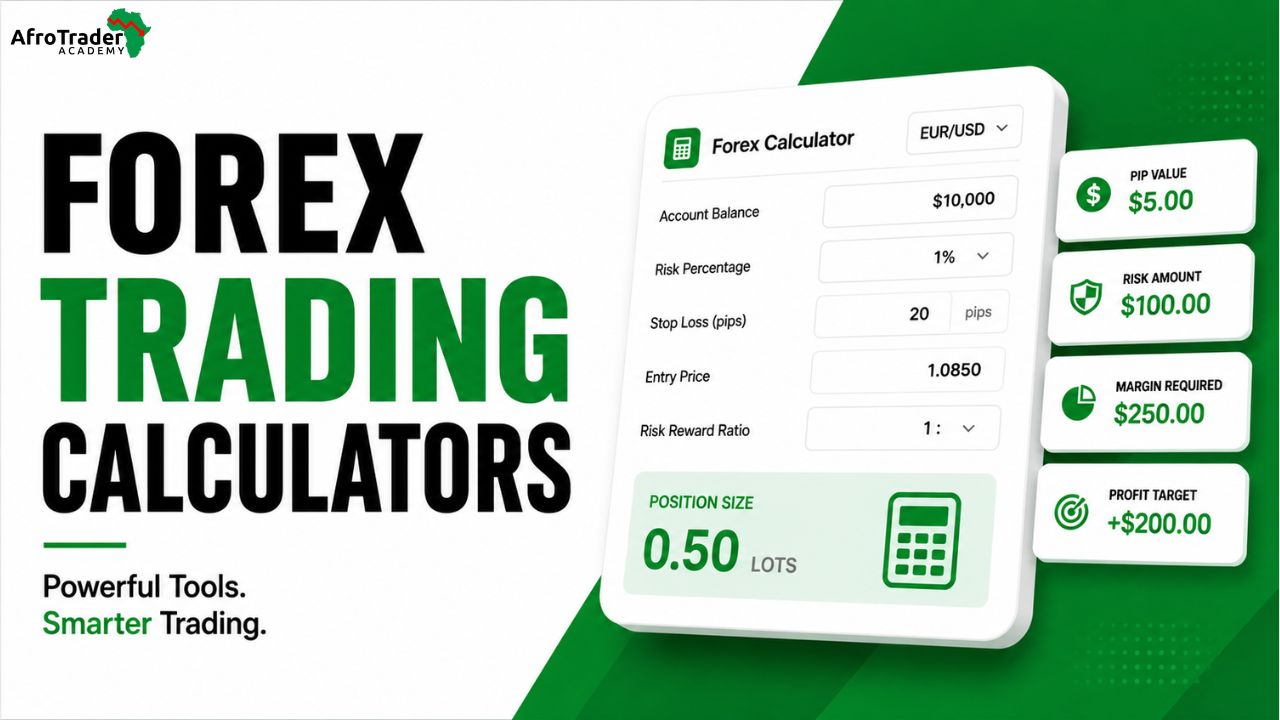
Use AfroTrader Academy’s Free Trading Calculators
Our free Position Size, Pip Value, Margin and Risk-to-Reward calculators help you apply correct risk management to every trade before you enter.
You can access our free trading calculators below:
Step 6 Build and Test Your Strategy on a Demo Account
A demo account is a live trading environment funded with virtual money. Prices are real, execution is real, the platform is real, but no actual capital is at risk. Every serious Forex broker provides a demo account for free, and every beginner should spend a minimum of two to three months trading exclusively on demo before considering any live capital.
Demo trading serves several critical functions for a beginner:
- Platform Familiarity: You learn how to place orders, set stop losses and take profits, read charts, and use platform tools without the risk of making costly operational mistakes.
- Strategy Testing: You can apply the technical analysis concepts you have learned in real market conditions and observe how your strategy performs over time without financial consequence.
- Risk Management Practice: You practise calculating position sizes, placing stop losses correctly, and adhering to daily loss limits before real money is involved.
- Emotional Discipline: While demo trading does not replicate the full emotional impact of live trading, it begins to build the habit of following rules and executing a plan rather than trading impulsively.
One important note: treat your demo account with the same seriousness you would a live account. Set it to the same balance you plan to start with on live. Apply the same risk rules. The habits you build on demo are the ones you will carry into live trading.
When Are You Ready to Go Live?
You are ready to move from demo to live trading when: you have been consistently profitable on demo for at least 2 to 3 months, you can apply your risk management rules without exception, you understand your strategy well enough to explain why you are entering every trade, and your emotional discipline is stable enough to accept losses without revenge trading.
Step 7 Create a Written Trading Plan
A trading plan is a written document that defines every aspect of how you trade. It is the difference between a trader and a gambler. A gambler makes decisions in real time based on emotion, excitement, and gut feel. A trader follows a pre-defined set of rules that govern every decision before, during, and after a trade.
Your trading plan does not need to be complex. It needs to be specific, written down, and followed consistently. At minimum, a beginner’s trading plan should define:
- Markets and Pairs: Which currency pairs you will trade and which you will not.
- Trading Sessions: Which market sessions you will trade based on your schedule and the pairs you have chosen.
- Strategy Rules: Your exact entry conditions. What must be true on a chart before you will enter a trade? The more specific, the better.
- Risk Parameters: Your risk per trade percentage, your stop loss methodology, your minimum risk-to-reward ratio, and your daily and weekly loss limits.
- Trade Management Rules: How you will manage open trades including whether and when you will move your stop loss to break even or trail it.
- Review Process: How frequently you will review your trading performance, what metrics you will track, and how you will use the data to improve.
Learn how to build your own live/prop-firm trading plan below:
Step 8 Start Live Trading Small
When you are consistently profitable on demo, your risk management rules are automatic, and your trading plan is written and tested, it is time to open a live account. The key word in that sentence is small. Starting small is not a sign of low ambition. It is the sign of a trader who understands that the transition from demo to live trading involves a psychological adjustment that cannot be replicated in simulation.
Live money creates emotions that demo money does not. Fear of losing, hesitation at entries, the temptation to move stop losses, the urge to revenge trade after a loss. These are real, and they affect every trader who goes live for the first time, regardless of how prepared they are on paper.
Starting small allows you to experience these emotions at a scale where the financial consequences are manageable, while you develop the discipline to override them. Here is a practical approach for going live:
- Start with the minimum deposit: Exness allows live account funding from as little as $10. Start with an amount you are completely comfortable losing while you adjust to live trading psychology.
- Trade micro lots only: Micro lots (0.01) keep your pip value at approximately $0.10, meaning a 50-pip loss costs $5. This is the appropriate scale for a new live trader.
- Apply the same rules as demo: Your risk per trade, stop loss placement, entry conditions, and daily loss limits must be identical to what you used on demo. No exceptions.
- Increase size gradually: Only increase your lot size and account funding after demonstrating at least one to two months of consistently profitable live trading with your current capital level.

Open Your First Live Forex Account
Exness is AfroTrader Academy’s recommended CFDs broker for beginner traders.
Open an account with Exness Broker
Use Referral Code:- 0rqvjitfb2 – (Stand a chance to win $30)
Step 9 Review, Journal, and Improve Continuously
Trading is not a destination. It is a continuous process of learning, testing, reviewing, and refining. The traders who progress most rapidly are not necessarily the most talented. They are the most disciplined reviewers. Every trade is a data point. Every loss contains information about what went wrong. Every win contains information about what worked.
A trading journal is the tool that converts that information into improvement. At minimum, your journal should record for every trade:
- The currency pair, direction, and time of entry
- Your entry price, stop loss, and take profit levels
- The reason for entry based on your trading plan criteria
- The outcome including profit or loss in pips and in money
- A brief note on your emotional state during the trade
- A post-trade review noting what you would do differently
Review your journal weekly. Look for patterns in your losing trades. Are you entering too early? Moving stop losses? Taking trades outside your strategy rules? The journal will show you, and what it shows you is the most valuable trading education you will ever receive.
The guide below will introduce you to what a trading journal is, how to build one and how it can make you a consistently profitable trader.
Beyond journaling, continue expanding your education. Markets evolve. Strategies need refinement. New concepts take time to fully internalise. Our Forex Course is designed to accompany you through this ongoing development, not just as a one-time resource but as a curriculum you return to as your experience grows.
The Most Common Mistakes Beginner Forex Traders Make
Understanding what not to do is as important as knowing what to do. Here are the mistakes that end most beginner trading accounts and how to avoid each one:
Trading Without Education
Opening a live account without first understanding how Forex works, how to read charts, and how to manage risk is the most expensive mistake a beginner can make. The market does not forgive ignorance. Spend adequate time in structured education before any live capital is involved.
Using Too Much Leverage
Brokers offer leverage of 1:100, 1:200, and sometimes higher. Many beginners treat this as an invitation to trade the maximum position their account allows. A small adverse move on an overleveraged position can wipe an account in minutes. Leverage is a tool for managing position size efficiently, not a mechanism for getting rich quickly.
Trading Without a Stop Loss
Every live trade must have a stop loss before entry. No exceptions. A trade without a stop loss has theoretically unlimited downside. Traders who skip stop losses typically do so because they are confident the trade will work. That confidence is irrelevant. Markets move in unpredictable ways including during news events, and a single unprotected trade can do more damage than dozens of losing trades with proper stop losses.
Switching Strategies Too Frequently
Every strategy goes through losing periods. Most beginners interpret a losing period as evidence that their strategy is broken and immediately switch to a new approach. This pattern, known as strategy-hopping, means they never stay with any single approach long enough to understand how it actually performs over time. Commit to one strategy, test it thoroughly on demo, and give it a genuine sample size before drawing conclusions.
Overtrading
More trades do not mean more profits. Overtrading, taking positions that do not fully meet your entry criteria, trading out of boredom, or attempting to recover losses quickly through volume, is one of the most reliable ways to drain an account. Quality over quantity is the professional standard.
Ignoring Fundamental Analysis
Technical analysis tells you what price is doing. Fundamental analysis tells you why. Major economic events such as central bank interest rate decisions, Non-Farm Payrolls (NFP) releases, and inflation data can cause sharp, rapid price moves that override any technical setup. Every Forex trader should check the economic calendar before their trading session and avoid holding positions through major high-impact news events until they understand how to manage that risk.
Essential Forex Glossary for Beginners
Here are the key terms you will encounter most frequently as a new Forex trader:
- Ask Price: The price at which you buy a currency pair. Also called the offer price.
- Bid Price: The price at which you sell a currency pair.
- Spread: The difference between the bid and ask price. Your trade starts at a small loss equal to the spread, which is how brokers earn revenue.
- Pip: The smallest standard price movement in most currency pairs (0.0001 for most pairs, 0.01 for JPY pairs).
- Lot: The standardised trade size in Forex. Standard = 100,000 units, Mini = 10,000 units, Micro = 1,000 units.
- Leverage: The ratio of capital you control versus the margin required. 1:100 leverage means $100 controls $10,000.
- Margin: The deposit required to open and maintain a leveraged trade.
- Stop Loss: A predefined price level at which your trade is automatically closed to limit losses.
- Take Profit: A predefined price level at which your trade is automatically closed to lock in profits.
- Long: Buying a currency pair in expectation that it will rise in value.
- Short: Selling a currency pair in expectation that it will fall in value.
- Bullish: Expecting price to move upward.
- Bearish: Expecting price to move downward.
- Liquidity: How easily and quickly an asset can be bought or sold without significantly affecting its price.
- Volatility: The degree of price movement over a given period. High volatility means larger, faster price swings.
- NFP: Non-Farm Payrolls. A monthly US economic report measuring employment changes that typically causes significant Forex market volatility on release.
- Risk-to-Reward Ratio: The ratio of potential profit to potential loss on a trade. A 1:2 ratio means risking $1 to potentially gain $2.
Final Thought
Starting Forex trading from zero is genuinely achievable. Thousands of traders across Africa and around the world have built consistent, profitable trading practices starting from no knowledge, no industry connections, and modest capital. The path exists.
What it requires is the same thing it has always required: structured education, disciplined risk management, consistent practice, and the patience to develop skills before expecting significant returns. Trading is not a get-rich-quick opportunity. It is a skill, and like every skill, it rewards those who take the time to learn it properly.
AfroTrader Academy was built specifically to provide that structure. Our Forex Trading Course walks you through every stage of this roadmap, from foundational concepts and chart reading to strategy development, risk management, and trading psychology, in a curriculum designed for traders who are serious about building a real, sustainable trading practice.
Every professional trader was once a beginner who chose to stay in the game long enough to get good at it. Staying in the game requires protecting your capital. Protecting your capital requires education and discipline. That is what AfroTrader Academy is here to help you build.
Risk Warning & Disclaimer
Trading Forex, Synthetic Indices, Cryptocurrencies and other leveraged financial instruments involves substantial risk and may not be suitable for all individuals. Leveraged trading can result in losses that exceed your initial capital. At AfroTrader Academy, we emphasize risk management, discipline and long-term consistency not shortcuts or guaranteed profits. The Academy provides educational content only and does not offer financial or investment advice. All trading decisions are the sole responsibility of the individual trader. Past performance does not guarantee future results. Please read our full Risk Disclosure and Disclaimer.


AfroTrader Academy is a professional trading education platform built to equip new and intermediate traders with the knowledge, structure, and discipline required to navigate modern financial markets. We focus on education over hype, process over profits, and skill development over shortcuts. Our mission is to help traders build a solid foundation, understand market behaviour, and develop repeatable trading frameworks they can apply independently.